
Anúncios
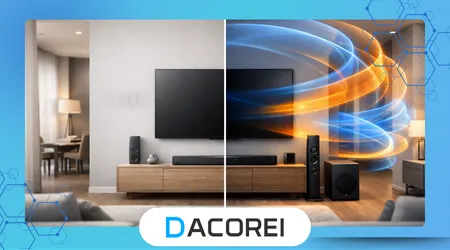
TV soundbar benefits become immediately apparent when viewers replace built-in television speakers with dedicated external audio systems. This article examines how soundbars and external speakers redefine clarity, immersion, dialogue intelligibility, spatial perception, and overall home entertainment performance standards.
Modern televisions prioritize slim industrial design, leaving minimal internal space for robust acoustic chambers. As a result, integrated speakers often lack depth, dynamic range, and directional accuracy required for cinematic or sports-oriented audio environments.
Consumers frequently invest in higher resolution panels such as 4K and OLED displays while overlooking the audio component. This imbalance creates a perceptual gap where stunning visuals coexist with compressed, flat, and underpowered sound reproduction.
Soundbars and external speaker systems directly address this imbalance through expanded driver arrays and acoustic engineering. They redistribute frequencies across dedicated tweeters, midrange drivers, and subwoofers to deliver balanced output across the audible spectrum.
Beyond volume enhancement, these systems improve articulation of dialogue and separation of effects. Viewers perceive layered soundscapes rather than blended noise, which transforms how films, series, games, and live broadcasts are interpreted emotionally.
Anúncios
This analysis explores technical foundations, psychological impact, installation considerations, and measurable performance differences. It also evaluates cost efficiency, room acoustics, connectivity standards, and real-world use cases shaping the contemporary television experience.
Why Built-In TV Speakers Fall Short
Manufacturers design ultra-thin televisions with limited enclosure depth and narrow acoustic cavities. These structural constraints prevent drivers from moving sufficient air to produce full-bodied bass and spatial resonance.
Small downward-firing speakers rely heavily on digital processing to simulate depth. Virtual enhancement cannot replace physical displacement of air required for authentic low-frequency reproduction.
Dialogue clarity often suffers because midrange frequencies compete with background effects in compact drivers. Viewers increase volume to compensate, which amplifies distortion rather than improving intelligibility.
Dynamic range compression further reduces emotional impact during action scenes. Explosions, orchestral swells, and crowd noise flatten into uniform loudness levels.
Television cabinets lack forward-facing dispersion patterns that project sound toward seating areas. Audio reflects off walls unpredictably, reducing directional precision and stereo imaging.
Low-frequency roll-off remains one of the most critical weaknesses in integrated systems. Without dedicated subwoofers, bass frequencies below approximately 100 Hz lack presence and weight.
Sports broadcasts highlight these limitations through subdued stadium ambience and muffled commentary. The experience feels distant instead of immersive and energetic.
Gaming environments also suffer from restricted spatial awareness. Positional cues such as footsteps or directional effects become harder to distinguish.
Even high-end televisions cannot overcome physical limitations imposed by slim chassis design. Audio performance remains secondary to visual engineering priorities.
++The Real Difference Between Live TV and On-Demand Streaming
How Soundbars Enhance Clarity and Presence
Soundbars integrate multiple drivers within a single horizontal enclosure positioned directly below the display. This alignment projects sound forward toward viewers, improving articulation and perceived loudness without distortion.
Dedicated center channels prioritize dialogue reproduction and isolate speech from ambient effects. This configuration reduces listening fatigue during extended viewing sessions.
Many models incorporate separate wireless subwoofers that handle low-frequency content. The physical relocation of bass drivers dramatically increases impact and room-filling energy.
Independent testing from the Audio Engineering Society highlights how multi-driver configurations improve frequency response consistency across listening positions. Structured acoustic design outperforms compact integrated television speakers in measurable clarity metrics.
Manufacturers employ digital signal processing to simulate surround effects through beamforming techniques. These algorithms direct sound waves at angles that reflect off walls to create perceived spatial expansion.
High-resolution audio support enhances compatibility with modern streaming formats. Systems decode Dolby and DTS signals with greater precision than standard television speakers.
Below is a simplified comparison between integrated TV speakers and soundbars:
| Recurso | Built-In TV Speakers | Soundbar System |
|---|---|---|
| Driver Size | Very small | Larger multi-driver array |
| Bass Output | Mínimo | Dedicated subwoofer |
| Dialogue Clarity | Moderate to weak | Enhanced center channel |
| Spatial Imaging | Limitado | Simulated or real surround |
| Volume Headroom | Restricted | Higher without distortion |
Installation simplicity remains a major advantage over full home theater systems. Users connect via HDMI eARC or optical cables without complex wiring schemes.
Price-to-performance ratio makes soundbars accessible for most households seeking noticeable improvement. Incremental investment produces disproportionately strong experiential gains.
External Speakers and True Surround Sound

Full external speaker systems extend beyond the compact format of soundbars. They distribute audio across multiple discrete channels positioned strategically around the listening area.
A traditional 5.1 or 7.1 configuration includes front, center, rear, and subwoofer components. This arrangement enables precise localization of sound events within three-dimensional space.
Pesquisas da Instituto Nacional de Padrões e Tecnologia on acoustic measurement demonstrates how room placement influences spatial perception. Accurate calibration enhances directional cues and perceived realism.
Unlike virtual surround simulation, discrete speakers reproduce independent audio channels physically. This approach maintains integrity of original studio mixes.
Home theater receivers manage amplification and signal routing across channels. They ensure balanced output levels and time alignment between speakers.
Rear speakers contribute significantly to environmental immersion during films and games. Ambient sounds wrap around the listener rather than projecting solely from the screen area.
Subwoofer placement impacts tactile sensation of bass frequencies. Strategic positioning optimizes standing wave distribution within the room.
While installation requires more planning than soundbars, performance scales accordingly. Enthusiasts prioritize accuracy over convenience.
Dedicated external speakers often use larger cabinets and higher-grade materials. These physical attributes translate directly into richer tonal depth and extended frequency response.
Impact on Streaming, Sports, and Gaming
Streaming platforms increasingly deliver content encoded in advanced audio formats. Enhanced speaker systems unlock the full benefit of these encoding standards.
The Federal Communications Commission provides technical documentation on digital audio transmission standards influencing broadcast and streaming quality. Proper hardware ensures compliance with intended playback fidelity.
During live sports, external audio systems reproduce crowd reactions and commentary separation distinctly. Stadium atmosphere feels expansive rather than compressed.
Action films benefit from dynamic contrast between quiet dialogue and explosive sequences. Enhanced systems preserve this contrast without clipping.
Gaming environments rely heavily on positional audio cues for competitive advantage. Surround systems improve spatial awareness significantly.
Streaming concerts and documentaries also gain dimensional realism. Instrument separation becomes more perceptible across stereo fields.
News broadcasts benefit from improved vocal articulation and reduced background muddiness. Anchors sound closer and more direct.
Family viewing environments experience less strain at moderate volume levels. Clearer dialogue reduces the need for excessive amplification.
Overall, diversified content categories demonstrate consistent audio improvement when external systems replace integrated speakers.
Como as plataformas de streaming decidem quando remover filmes e séries
Room Acoustics and Placement Strategy
Room dimensions influence how sound propagates and reflects. Hard surfaces amplify echoes while soft materials absorb specific frequencies.
Strategic placement of soundbars directly below the television aligns audio with visual focus. This reduces perceptual dislocation between voice and image.
External speakers require careful angling toward primary seating positions. Toe-in adjustments refine stereo imaging.
Subwoofer positioning avoids excessive corner boominess. Balanced placement prevents overpowering low-frequency resonance.
Calibration tools included in many receivers measure room response automatically. Microphone-based tuning optimizes delay and equalization.
Furniture layout affects sound dispersion patterns significantly. Open layouts produce different acoustic reflections than enclosed rooms.
Wall-mounted televisions may require adjusted soundbar height alignment. Proper elevation preserves direct sound projection.
Rugs and curtains function as passive acoustic treatments. They mitigate high-frequency reflections.
Careful planning transforms average rooms into acoustically balanced environments. Intentional setup maximizes hardware investment.
Cost, Longevity, and Value Considerations
Consumers evaluate cost relative to perceptible improvement in daily use. Soundbars offer efficient upgrades without structural remodeling.
External speaker systems represent higher upfront investment but longer lifecycle value. Modular components allow incremental upgrades.
Durability depends on amplifier quality and driver construction materials. Well-built systems operate reliably for years.
Energy consumption remains moderate compared to large home theater amplifiers. Modern systems incorporate efficient power management.
Wireless connectivity reduces cable clutter in contemporary living rooms. Bluetooth and Wi-Fi integration expand use cases beyond television.
Software updates extend compatibility with emerging formats. Manufacturers release firmware enhancements periodically.
Resale value remains relatively stable for reputable brands. Audio equipment depreciates slower than display technology.
Future-proofing depends on HDMI standards and decoding capability. Selecting systems with eARC compatibility supports long-term relevance.
Cost-benefit analysis consistently favors external audio investment for viewers prioritizing immersive media consumption.
++Por que alguns filmes e séries ficam melhores em uma TV do que em outra
Conclusão
Soundbars and external speakers fundamentally reshape the television experience through measurable acoustic improvements. They restore balance between visual fidelity and auditory performance.
Built-in television speakers remain constrained by physical design limitations. External systems compensate with engineered acoustic capacity.
Dialogue clarity improves immediately after installation of dedicated center channels. Viewers notice reduced strain and enhanced comprehension.
Bass response transforms emotional engagement during action scenes. Subwoofers introduce tactile dimension absent in integrated systems.
Spatial imaging enhances realism across films, sports, and games. Surround configurations extend immersion beyond the screen.
Room acoustics influence outcomes significantly. Proper placement and calibration maximize performance gains.
Streaming platforms increasingly support advanced audio codecs. External systems unlock full potential of these formats.
Investment scale varies from compact soundbars to full surround arrays. Each tier provides proportional experiential enhancement.
Long-term durability and modularity increase overall value proposition. Audio systems typically outlast display technology cycles.
Ultimately, prioritizing sound quality elevates everyday viewing into a more cinematic and emotionally resonant experience.
Perguntas frequentes
1. Do soundbars significantly improve dialogue clarity?
Yes, soundbars with dedicated center channels isolate vocal frequencies and reduce background interference, resulting in clearer speech reproduction compared to standard television speakers.
2. Is a subwoofer necessary for noticeable improvement?
A subwoofer substantially enhances low-frequency response and adds depth to action scenes, music, and sports broadcasts, making overall audio reproduction feel fuller and more immersive.
3. Are wireless soundbars reliable for high-quality audio?
Modern wireless soundbars using HDMI eARC or Wi-Fi transmission maintain high fidelity with minimal latency, ensuring synchronized audio without perceptible degradation.
4. Does room size affect soundbar performance?
Room dimensions influence reflection patterns and bass distribution, but proper placement and calibration allow soundbars to perform effectively in small and medium environments.
5. Are external speakers better than soundbars?
Discrete external speaker systems provide superior channel separation and spatial precision, though they require more space, wiring, and configuration effort.
6. Can external speakers improve gaming performance?
Yes, surround configurations enhance directional awareness and positional audio cues, supporting competitive gameplay and immersive single-player experiences.
7. How long do soundbars typically last?
Quality soundbars often function reliably for several years, especially when manufacturers provide firmware updates and maintain component durability standards.
8. Is upgrading audio more impactful than upgrading screen size?
For many viewers, improved sound quality delivers more immediate perceptual enhancement than incremental increases in screen size, particularly when existing displays already support high resolution.